As the 2026/27 Fantasy Premier League season progresses, Gameweek 2 is set to kick off this Friday. Managers need to consider their defensive lineups carefully, informed by the projected clean sheet probabilities for each team. While many managers look to grab attacking players who can score goals, a nuanced approach towards defence can be just as pivotal in making competitive decisions for their squads.
This week, we utilized the Fantasy Football Scout Fixture Ticker to evaluate the clean sheet chances, essential information for FPL managers making decisions about defensive picks, transfers, and their starting eleven. Fantasy Premier League managers often overlook the defensive aspect of squad management, but those who prioritize it can find themselves gaining a crucial edge in head-to-head matchups.
GAMEWEEK 2: CLEAN SHEET PERCENTAGES
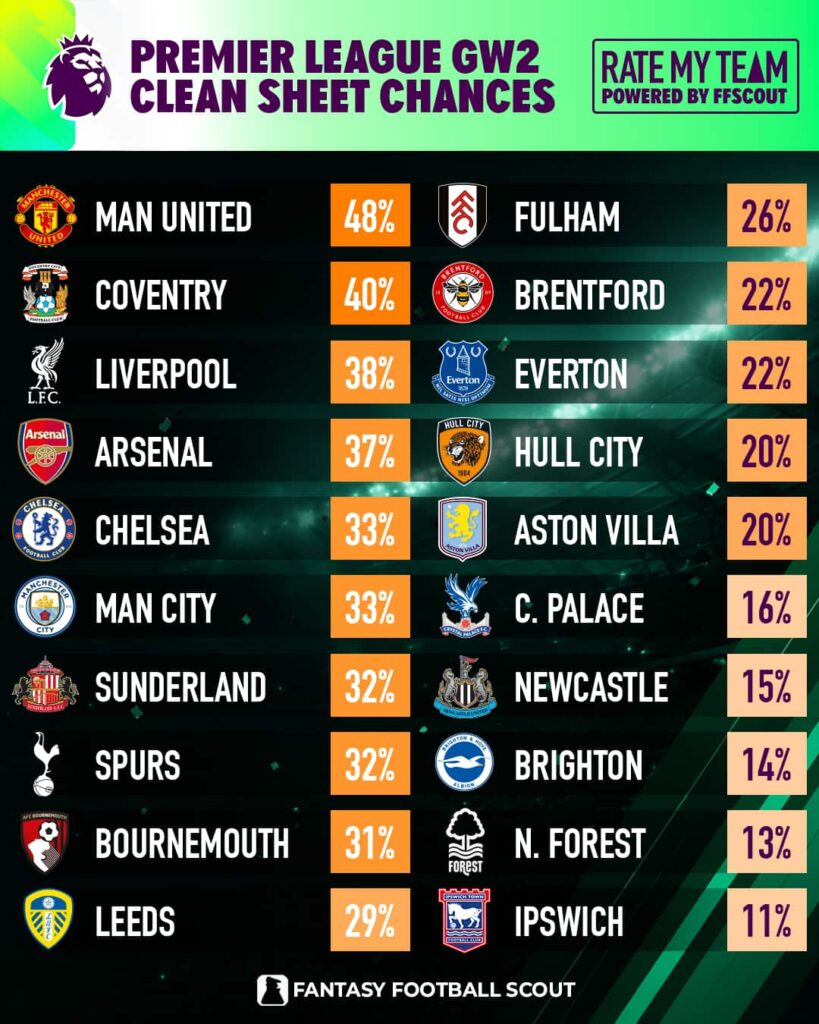
Leading the pack this week, Manchester United boasts a 48% chance of keeping a clean sheet against Ipswich Town after a disappointing loss to Hull City in their opener. After their shaky start, the team’s defensive strategy will be under scrutiny, and many expect a more determined performance. If they can tighten their back line, it might be the turnaround they need.
They’re not alone, as Coventry City comes in with a 40% probability as they face Hull at home. Managers should keep an eye on Coventry, who started positively against United. The fact that they have shown resilience against stronger teams could make them an appealing option as a defensive pick this week.
Following closely are Liverpool and Arsenal. Liverpool, coming off a 2-2 draw, will aim for their first clean sheet against Nottingham Forest, while defending champions Arsenal look to bounce back against Aston Villa, who had a lackluster start. The pressure is on both clubs, and how they respond under scrutiny often dictates their potential for clean sheets, as defensive cohesion can shift dramatically with pressure.
Other teams exceeding a 30% chance include Chelsea, Manchester City, Sunderland, Tottenham Hotspur, and Bournemouth. These teams have the potential to surprise this week, and it’s worth watching how their defenses hold up against varying styles of attack.
In the lower tiers of the projections, Ipswich, Nottingham Forest, Brighton and Hove Albion, Newcastle United, and Crystal Palace show less than a 20% chance. Brighton did manage a shutout in their opener but faces a challenging Chelsea side this week. It’s a challenging task for them; even having started strong, the odds seem stacked against them in this fixture. If they can pull off a clean sheet, it could set a precedent for the season ahead.
LOOKING FURTHER AHEAD

Beyond this week, a glance at the ticker reveals Arsenal leading the clean sheet probabilities for the next six Gameweeks, with Liverpool closely behind, guaranteeing a minimum of 38% odds in the next rounds. Both teams exhibit defensive resilience that managers will want to exploit, especially as form fluctuates throughout the season.
Manchester United shows promising projections over the next month, needing to improve significantly from their Gameweek 1 display. This upcoming spell could prove critical; slipping behind could have unfavorable ramifications throughout the season.
In contrast, Sunderland and Brentford feature towards the bottom of the odds, indicating a tough road ahead. This can sway managers away from relying on their defensive picks, as lower odds often correlate with higher risks. If you’re working in this space and drafting players for upcoming games, consider these factors. Keeping a close eye on fixtures and form can help in selecting the appropriate players.

WHAT THIS MEANS FOR MANAGERS
For Fantasy Premier League managers, these statistics and projections have tangible implications. Clean sheets not only provide defensive points but can also influence transfer strategies in upcoming weeks. Managers need to balance risk and reward as they craft their teams. Do you back a strong defense with higher clean sheet odds, or do you gamble on attacking potentials? You probably can’t have it both ways without a few compromises.
This is more significant than it looks. Managers who frequently pivot to high-risk attacking players may find their overall scores suffering against more tactically sound teams that excel defensively. And yet, as each Gameweek unfolds, the unpredictability of football ensures that no strategy is foolproof. Keeping tabs on performance data, fixture difficulty, and player form is paramount. If the early weeks are telling, managers must adapt quickly. The competition waits for no one, and an edge could be lost in mere moments.